Info@bukitlawangtravel.com

Start Your Adventure in the Sumatran Rainforest
Start your adventure in the Sumatran rainforest with ethical orangutan trekking, wildlife insights, conservation facts, and Bukit Lawang travel advice.

A Sumatran rainforest adventure is not a zoo visit with better scenery. It is a chance to walk beneath towering rainforest trees, hear gibbons calling through the canopy, and witness a living ecosystem that still holds some of Asia’s rarest wildlife. Start your adventure in the Sumatran rainforest with respect for the forest, the animals, and the communities whose livelihoods are connected to protecting it.
Gunung Leuser National Park in North Sumatra is one of the most significant places on Earth for tropical biodiversity. For many visitors, Bukit Lawang is the natural gateway: a riverside village where locally guided trekking creates a meaningful way to meet the forest on its own terms.
Why Gunung Leuser National Park Matters
Gunung Leuser National Park is part of the Tropical Rainforest Heritage of Sumatra, a UNESCO World Heritage site recognized in 2004. In 2011, the wider heritage site was placed on UNESCO’s List of World Heritage in Danger, a reminder that its extraordinary wildlife and forests cannot be taken for granted.
The national park itself covers nearly 800,000 hectares, while the broader Leuser Ecosystem stretches much farther across northern Sumatra. This vast landscape includes lowland rainforest, steep mountain slopes, rivers, waterfalls, peatlands, and the summit of Mount Leuser, which rises to about 11,168 feet. That range of habitats is one reason the area supports so many species.
This is one of the few remaining landscapes where Sumatran orangutans, elephants, tigers, and rhinoceroses occur within the same ecosystem. Seeing all four in the wild is exceptionally rare, especially the tiger and rhino. Their presence matters because it shows what the forest still supports, not what travelers should expect to see on a trek.
For most visitors, the most realistic wildlife encounters are orangutans, Thomas’s leaf monkeys, long-tailed macaques, pig-tailed macaques, gibbons, siamang, hornbills, monitor lizards, and a remarkable variety of insects and birds. A good trek is never a checklist. The jungle decides what it reveals.
Start Your Adventure in the Sumatran Rainforest Responsibly
The best rainforest experience begins with a simple mindset: you are a guest in a wild home. Ethical trekking protects the chance of wildlife encounters while reducing stress and disease risks for the animals.
Orangutans are the reason many travelers come to Bukit Lawang, and they deserve special care. Wild orangutans should never be fed, touched, called toward, or crowded for a photo. Human illnesses can be dangerous to them, and food-conditioned animals can lose the behaviors that help them survive independently. Keep a respectful distance, follow your guide’s instructions, and do not join a trek if you are sick.
A certified local guide does more than show the route. They read animal behavior, choose paths that reduce disturbance, respond calmly to changing conditions, and share the forest knowledge passed through local experience. They also help guests understand that a quiet moment watching an orangutan feed naturally is more valuable than a close encounter created for entertainment.
Responsible trekking also means staying on appropriate routes, carrying out all waste, using refillable water bottles where possible, and avoiding single-use plastics. In a humid forest, even small choices add up. Nothing brought into the jungle should be left behind.
The Wildlife You May Meet
Sumatra’s rainforest is often described as one of Southeast Asia’s richest ecosystems. The numbers vary by survey area and classification, but the scale is clear: the Leuser landscape holds hundreds of bird species, hundreds of reptiles and amphibians, more than 200 mammal species, and thousands of plant species.
Orangutans and other primates
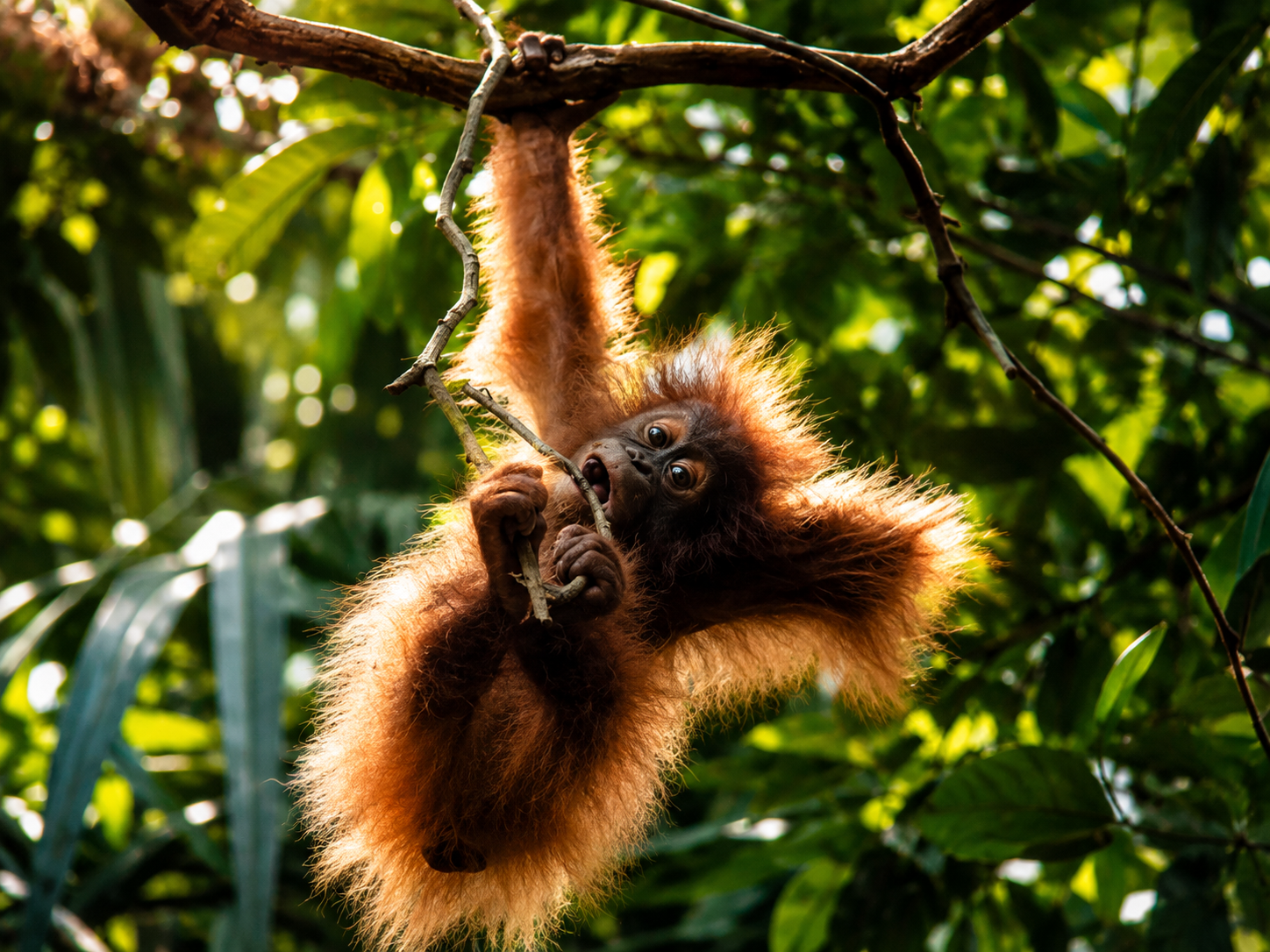
The Sumatran orangutan is critically endangered, and Gunung Leuser remains one of its most important strongholds. These powerful, thoughtful great apes spend much of their lives in the trees, traveling through the canopy, building nests, and searching for fruit. A mother with a young orangutan is a particularly moving sight, but it should always be observed quietly and from a safe distance.
You may also see Thomas’s leaf monkeys, known for their striking black-and-white coloring and lively family groups. White-handed gibbons and siamang are often heard before they are seen. Their calls can carry across the forest early in the morning, turning the canopy into a natural concert hall.
Macaques are common, clever, and sometimes bold around human activity. Keep snacks packed away and never offer food. Feeding monkeys changes their behavior and can create unsafe situations for both wildlife and visitors.
Rare animals that need room to remain wild
The Sumatran tiger, elephant, rhinoceros, and slow loris all face intense pressure from habitat loss, poaching, and fragmentation. A multi-day trek may reveal tracks, calls, feeding signs, or other evidence of animals you never see. That is part of a healthy wilderness experience.
No ethical guide should promise tiger, elephant, or rhino sightings. These animals need space and distance from people. Their absence from your path is not disappointment. It can mean they still have the freedom to move through the forest without being pursued by tourism.
Plants that make the forest work
The rainforest is not merely a backdrop for animals. Giant trees, lianas, fungi, ferns, medicinal plants, and fruiting species form the foundation of the ecosystem. Sumatra is also known for spectacular flowering plants, including Rafflesia arnoldii, famous for producing the world’s largest individual flower, and Amorphophallus titanum, often called the titan arum.
These blooms are seasonal, unpredictable, and easy to damage. A Rafflesia excursion should be approached with the same patience as wildlife trekking: there is no guarantee, but the search itself reveals much more about the forest.
Choose a Trek That Fits Your Travel Style
You do not need to be an experienced backpacker to experience Gunung Leuser. The right trip depends on your fitness, available time, comfort level, and what you hope to take away from the day.
A three-hour or half-day walk can suit families, first-time trekkers, and travelers with limited time. It offers an introduction to the forest’s sounds, terrain, and wildlife without requiring a full day of hiking. A full-day trek provides more time away from the village edge and a better sense of the rainforest’s changing rhythms.
For travelers seeking a deeper experience, overnight and multi-day expeditions trade comfort for immersion. Expect uneven ground, heat, humidity, muddy sections, river crossings, and basic jungle camping. In return, you may fall asleep to cicadas and wake to gibbon calls, far from roads and schedules.
Night trekking is a different kind of adventure. It focuses less on large mammals and more on small nocturnal life: insects, frogs, spiders, geckos, and perhaps a slow loris if conditions and luck allow. It should be led carefully, with low-impact lighting and no attempt to disturb or handle animals.
What to Pack for the Jungle
Packing well can make a demanding trek far more enjoyable. The rainforest is warm, wet, and slippery even when the morning begins sunny. Wear lightweight clothes that you do not mind getting muddy, and choose shoes with reliable grip. Leech socks can be useful in wet conditions, while a small dry bag protects your phone, camera, and passport copies.
Bring a reusable water bottle, insect repellent, sunscreen for time outside the canopy, personal medication, and a small first-aid kit for minor needs. Long socks and long pants can provide extra protection from scratches, insects, and leeches. Leave valuables and unnecessary packaging at your accommodation.
Your guide can advise what is needed for your specific trek, particularly for overnight trips. Ask before departure about meals, sleeping arrangements, water, transportation, and any dietary requirements. Clear planning allows you to focus on the experience once you enter the forest.
Tourism Can Help, but Only When It Is Done Well
Palm oil expansion, illegal logging, road development, mining, agricultural encroachment, and poaching have put enormous pressure on Sumatra’s remaining forests. Conservation is not solved by a visitor simply arriving in the village. It depends on how that visit is organized and where the money goes.
Community-based ecotourism can provide local income through guiding, accommodation, transport, food, crafts, and village activities. When families can build livelihoods connected to a healthy forest, protecting wildlife becomes more practical as well as more personal. But tourism has limits: overcrowding, poor guiding, wildlife feeding, and waste can cause real harm. Choose operators that place animal welfare and local benefit ahead of guaranteed sightings or staged encounters.
At Bukit Lawang Travel, locally rooted guiding is part of that commitment. The goal is not to make the rainforest perform. It is to help guests experience it safely, respectfully, and with a better understanding of why it must remain standing.
Come ready for mud on your shoes, humidity in the air, and plans that may shift with the weather. The reward is not only the possibility of seeing an orangutan high in the trees. It is leaving with a stronger connection to one of the world’s irreplaceable forests, and knowing your adventure helped value it as a living home.
[…] the dramatic open views of the Karo Highlands and Lake Toba, many travelers continue toward the rainforest landscapes around Bukit […]