Info@bukitlawangtravel.com

Wildlife in Sumatra and the Leuser Ecosystem
Plan a responsible encounter with Wildlife in Sumatra and Leuser Ecosystem, from orangutans to forest birds, with practical ethical trekking advice today.

A glimpse of orange fur high in the canopy can stop an entire jungle trail in its tracks. But orangutans are only one part of a rainforest that hums, calls, crawls, and grows in every direction. For travelers searching for Wildlife in Sumatra and Leuser Ecosystem, the most meaningful experience is not a checklist of animal sightings. It is learning how this living forest works, and how to visit it without asking wildlife to change its behavior for us.
The Leuser Ecosystem is one of Southeast Asia’s great remaining rainforest landscapes. Around Bukit Lawang, guided trekking offers a rare chance to walk beneath towering trees and look for wildlife in its natural habitat. Some days bring close sightings. Other days bring more birdsong, fresh tracks, giant leaves, and the quiet reminder that a wild forest does not perform on demand. Both are part of the adventure.
Why the Leuser Ecosystem matters
The Leuser Ecosystem stretches across a vast area of northern Sumatra, linking protected forests, rivers, mountain terrain, and lowland habitats. Gunung Leuser National Park forms an essential protected core, but wildlife does not recognize park boundaries. Animals need connected forest beyond a single marked line on a map.
This is one of the few places on Earth where critically endangered Sumatran orangutans, Sumatran tigers, Sumatran elephants, and Sumatran rhinos still share the wider landscape. Seeing all four is extraordinarily unlikely for a visitor, and that rarity is the point. These species need large, intact, protected habitat to survive.
Rainforest conservation here is also about people. Healthy forests help protect water sources, reduce erosion, support local livelihoods, and sustain communities that have long lived beside the jungle. Responsible tourism can create income tied to keeping the forest standing, provided it is led carefully, employs local people, and puts animal welfare ahead of a guaranteed photo.
The animals travelers are most likely to see
Sumatran orangutans
Orangutans are the rainforest’s best-known residents, and for good reason. Watching one move through the canopy with calm purpose is a powerful experience. In the Bukit Lawang area, visitors may encounter semi-wild orangutans near established trekking routes as well as fully wild individuals deeper in the forest.
An orangutan sighting is never a promise, even on a well-guided trek. Fruit availability, weather, time of day, recent forest activity, and plain luck all affect where they travel. A certified local guide reads the forest through sounds, feeding signs, nests, and experience, but should never chase, corner, call in, or feed an orangutan.
Keep a respectful distance, stay quiet, and follow your guide’s instructions immediately. Orangutans are strong wild animals, not props for portraits. Guests who are sick, especially with a cough, fever, or cold-like symptoms, should not trek near great apes. Human respiratory illness can be dangerous for them.
Thomas’s leaf monkeys and macaques
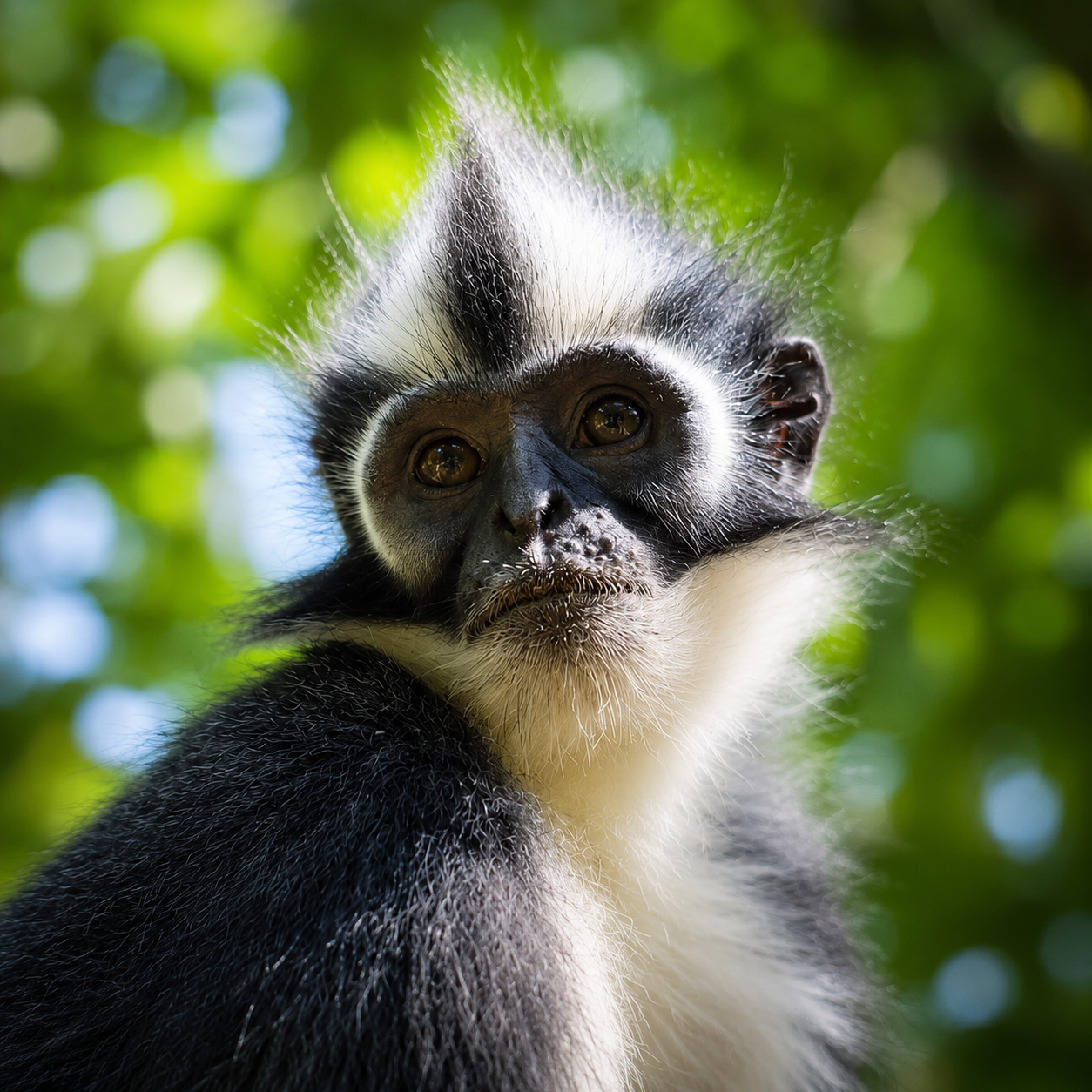
Thomas’s leaf monkeys are a beautiful local highlight, with dark faces, pale fur, and long tails. They often move in energetic groups through the mid-level canopy, sometimes pausing long enough for a careful look. Long-tailed macaques and pig-tailed macaques may also appear around the forest edge or along trails.
Monkeys can be curious, especially where people have handled food carelessly. Keep snacks sealed in your pack and never offer food. Feeding changes natural behavior, encourages conflict, and can make wildlife dependent on people.
Gibbons, birds, reptiles, and smaller forest life
You may hear a gibbon before you see one. Their morning calls can carry through the rainforest and are among the most memorable sounds of a trek. Agile gibbons move quickly through high branches, so a clear view takes patience and a little luck.
The forest also rewards travelers who look beyond large mammals. Hornbills, drongos, barbets, kingfishers, and other birds bring movement and color to the canopy. Giant squirrels may race along branches. Butterflies gather near damp ground, while leaf insects, stick insects, frogs, and lizards reveal themselves only when you slow down.
Snakes live in the rainforest too, although most visitors never see one. This is why proper footwear, staying on the route, and walking with an experienced guide matter. Good jungle trekking is not about taking unnecessary risks. It is about moving attentively through a place where you are a guest.
Wildlife in Sumatra and the Leuser Ecosystem: what not to expect
The most responsible wildlife trips set honest expectations. You are not visiting a zoo, and no ethical guide can guarantee a tiger, elephant, or even an orangutan encounter. Sumatran tigers are extremely elusive. Elephants are generally found in other areas of the broader ecosystem rather than on a typical Bukit Lawang jungle trek. Sumatran rhinos are so rare and protected that travelers should not expect to see them at all.
This may sound less exciting than a dramatic wildlife promise, but it is actually what makes the forest valuable. Wild animals remain wild because they have space to avoid people. A quiet trail, a distant call, or fresh elephant signs can be just as meaningful as a close encounter when you understand what those signs represent.
Be cautious of experiences that advertise touching, holding, bathing with, or feeding wild animals. The same applies to tours that crowd around an orangutan or offer unusually close photographs as the main attraction. Ethical wildlife viewing gives the animal room to choose where it goes next.
How to trek responsibly in Bukit Lawang
Your choices before and during a trek shape its impact. Choose a locally based operator that uses certified guides, maintains small groups where possible, and is clear about wildlife-distance rules. Ask how the company handles food, waste, sick guests, and animal encounters. A trustworthy answer will focus on the animal’s welfare rather than selling a perfect sighting.
Bring a refillable water bottle, rain protection, modest trail clothing, insect repellent, and shoes with reliable grip. The rainforest is hot, humid, and often muddy. A three-hour walk can be a wonderful introduction for families or travelers with limited time, while a longer trek offers more time to absorb the forest’s rhythms. Multi-day expeditions can reach quieter areas, but they also require greater fitness, careful camping practices, and a willingness to accept changing conditions.
On the trail, keep your voice low and your phone on silent. Do not play animal sounds to attract wildlife. Avoid flash photography, particularly in low light, and never leave tissues, wrappers, or food scraps behind. If your guide asks the group to step back, wait, or change direction, that is not a missed opportunity. It is responsible guiding in action.
Travel that supports the people protecting the forest
Conservation works best when nearby communities benefit from protecting nature. Staying in locally owned accommodation, hiring local guides, eating at village businesses, and choosing community-based activities all help keep visitor spending in Bukit Lawang. That local economic value gives responsible tourism a practical role alongside formal conservation efforts.
Bukit Lawang Travel is family-owned and locally based, with certified guides who know that the best jungle experience is built on respect: respect for guests’ safety, for wildlife boundaries, and for the community that calls this forest home. Whether you choose a short walk or a multi-day expedition, the goal is the same – to leave with stronger memories and a lighter footprint.
Come prepared to be surprised by more than orangutans. Look up for movement in the canopy, listen for the forest at dawn, and let your guide show you the smaller signs that many travelers walk past. That patient way of seeing is where a rainforest journey becomes an adventure that matters.